Bywater Mural Guide: Self-Guided Street Art & Blue Bikes NOLA
Key Takeaways
- Bywater is one of New Orleans’ best neighborhoods for exploring street art, with dozens of murals spread across walkable and bike-friendly streets.
- Use the self-guided mural map as a starting point, not a fixed tour. Murals change constantly, so wandering and discovering unexpected pieces is part of the experience.
- Make a day of it. Grab a Blue Bike, explore the murals, ride Crescent Park, and mix in neighborhood food, drinks, music, and local stops along the way.
I love being a part-time resident of Bywater and look forward to the coming years as my time here increases. In an amazing city with so much to offer, Bywater remains my favorite place to be. This Bywater mural guide is my excuse to carry on about running Crescent Park to the Quarter and beyond, food and drink, architecture, the people, and how this neighborhood makes me feel—but today, it’s murals.
Quick pics from a Sunday morning… coffee, a bike and an iphone. More of what’s special to me about this neighborhood.


A Grown City Kid’s Perspective
was a kid in Queens in the ’70s and ’80s, then lived in Manhattan in the ’90s. New York was gritty, crowded, and imperfect, but it was still possible for ordinary people to carve out a life there.
My Manhattan was a cheap 400-square-foot walk-up, expensive brownstones around the corner, a city park with a homeless camp a block over, and everybody moving through the same neighborhood with a basic degree of respect. It was not a fantasy city, but it was a real one. A living thing.
I think cities are supposed to be like that—positive microbiomes of life. A little messy. A lot of different people. People with money, people without much money, workers, artists, families, tourists, people in need and characters you cannot put into a demographic box. All mixed together. All working their own story and at times coming together. All making the place feel alive.
Much of urban America went through its so-called renaissance—often a long, expensive wave of redevelopment and gentrification. Call that argument for another day if it makes you angry too, but along with cleaner streets came a kind of cleansing that had nothing to do with trash. Too many cities lost their rough edges, their affordable corners, their soul, and the mix of people that made them vibrant.
At my current stage in life I spend most of my days in a small rural mountain town and love it, but I still feel the pull of the city. Through out my 37yr carrier building out restaurants and retail I have traveled the country’s cities as well as the world’s. I feel the call of the city, but not many in The States appeal to me any longer. New Orleans does. To me, it may be the last real American city for real people.
Why New Orleans Still Feels Real
Yes, New Orleans has changed, and yes, Bywater has changed with it. I know some people will rightly say gentrification is part of that story—and that newcomers like me are part of it too. Fair enough. But there is a difference between change and sterilization.
New Orleans still has layers. It is still that city I remember,where people with money, people without much money, artists, musicians, workers, tourists, longtime families, new comers like me and characters you cannot put into a demographic box all occupy the same streets.
So many cities have been polished into versions of each other. The same curated retail, the same restaurants, the same expensive apartments, and the same brick-and-steel architecture trying hard to look like it has always been there. New York, Chicago, San Francisco—take your pick. You can walk a few blocks and, if you did not know better, wonder where you are.
New Orleans does not feel like that. It still has neighborhood establishments locally owned, places that feel like they grew organically, on place, instead of being dropped in by a development company. The kind of place with real corner bars, not faux dives, and upscale restaurants sit right across the street from one another. The elite retail is here if you want it, but it is mostly contained: around Rau on Royal, maybe along Magazine in the Garden District. It has not swallowed the whole city.
That matters to me. A city needs to change to live, but it should not have to become interchangeable in the process.
Why Bywater Feels Like Home
And Bywater is where that larger New Orleans feeling becomes especially personal for me. It has beautiful historic homes and gardens, but also cracked sidewalks, worn corners, neighborhood bars, train tracks, murals on any available wall, and a constant reminder that this is a place where people actually live.
You can run Crescent Park toward the Quarter, stop for food or a drink, hear music drifting from somewhere nearby, and end up talking to somebody who has lived here forever—or somebody who arrived last week and is already in love with the place.
Bywater is creative, colorful, imperfect, and changing, but it has not forgotten how to feel human. That is what gets me. It feels like we all belong here in our own way—warts and concealer and all.
The Bywater Murals
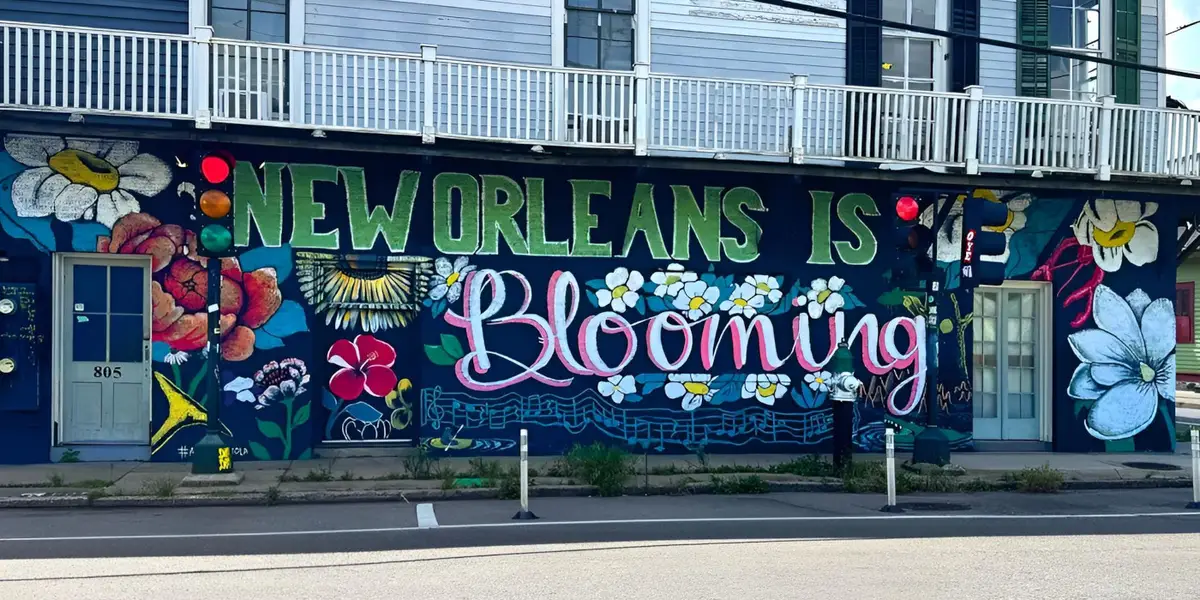
To the mural tour I promised. The Bywater murals make the neighborhood feel like an open-air gallery wrapped around easygoing food, drink, and late nights. The mural scene is part of a broader New Orleans street-art culture, with especially dense pockets here and in neighboring Marigny. Bywater’s walkable blocks, industrial walls, railroad edges, historic homes, galleries, and long-running creative community make it a natural place for public art. Murals get painted over, tagged, weathered, or replaced, so the visual landscape is always changing. That impermanence is part of the point: this is not a fixed outdoor museum so much as a neighborhood in conversation with itself.
Studio BE helped turn it into one of the city’s most visible mural destinations. Brandan “BMike” Odums’ Studio BE, located in Bywater, transformed a 35,000-square-foot warehouse into large-scale murals that center Black history, civil rights figures and community, making it a key part of the Bywater street-art story.. I highly recommend reading more at StudioBE, The Tulane Hullabaloo or My Modern Met.
My Self-Guided Bywater Mural Map
I’ve been meaning to do this for a while, so I finally jumped on my bike on a hot summer Sunday with an iPhone and started shooting. The map shows two dense clusters with a few in‑between stops. Consider this your self-guided Bywater mural guide, not a tour. The thirty‑plus pins are the ones I don’t think you should miss—call them the greatest hits to keep you oriented, not a turn‑by‑turn tour. And there are at least double, maybe triple, that number beyond the map: some tagged over, some DIY, some that just stop you hard. Keep your eyes open; if something off‑map grabs you, drop it in the comments and I’ll add it.
Nothing is set in stone—just have a great day. Ride over on Blue Bikes NOLA or grab one in the neighborhood—stations in Bywater are blue pins on the map. You can learn more about Blue Bikes and other options in our post, Comprehensive Guide to Bike Rentals in New Orleans.
Start with brunch and a cocktail at Elizabeth’s, a beer at Rip’s, and finish with bites and music at Bacchanal. Or don’t. It’s your day; wander, linger, detour.
A Note on the Bywater Mural Guide
An important note before you undertake your adventure: this is not an art-and-culture tour, and I’m not trying to impart the social impact of some of the murals. There’s a lot behind some of this art, and some is simply for beauty and fun. I’ve had conversations and done some reading to learn about pieces that touched me, but that’s for me; you should take this in as you decide. Consider this nothing more than a map at a museum—follow it as you enjoy, and take in whatever meaning you conjure. I’m simply hoping this Bywater mural guide introduces you to what’s out there in this great neighborhood.
For insight into murals across the city, this post on Dots On A Map is a great resource, as is this one from New Orleans Activities.
Frequently Asked Questions
Quick answers to common questions about exploring Bywater’s murals, street art, and neighborhood.
Where can I see murals in Bywater, New Orleans?
Murals are scattered throughout Bywater, with several dense clusters along neighborhood streets, industrial buildings, railroad edges, and around creative spaces such as Studio BE. The self-guided map in this guide highlights more than 30 murals and makes a good starting point for exploring.
Can I take a self-guided mural tour of Bywater?
Yes. Bywater is well suited for a self-guided mural tour because many murals are relatively close together and easy to reach on foot or by bike. There is no set route, so use the map to get oriented and wander between stops at your own pace.
What is the best way to explore the Bywater murals?
Walking works well for a smaller section of the neighborhood, but a bike makes it easier to cover more murals in one outing. Blue Bikes NOLA can be a convenient option, especially if you also want to ride Crescent Park or continue toward the French Quarter or Marigny.
How long does a Bywater mural tour take?
Plan on roughly two to three hours if you want to see a good number of murals without rushing. You can easily turn it into a half-day outing by stopping for food, drinks, music, or a ride through Crescent Park along the way.
Are the murals in Bywater permanent?
No. Murals can be painted over, weathered, tagged, restored, or replaced entirely. That constantly changing landscape is part of what makes exploring street art in Bywater interesting, and you may see pieces that are different from those shown in this guide.
Is Studio BE worth visiting while exploring Bywater?
Yes. Studio BE is one of the most significant street-art destinations in the neighborhood and an important part of New Orleans’ contemporary mural scene. Brandan “BMike” Odums transformed the large warehouse space with work centered on Black history, civil rights, community, and culture.
What else can I do while exploring murals in Bywater?
Bywater is easy to turn into a full neighborhood outing. You can combine the murals with a ride through Crescent Park, brunch, drinks at a neighborhood bar, live music, local restaurants, galleries, and simply wandering through the area’s historic residential streets.

Rob Herrmann
Based in Spearfish at the edge of the Black Hills with an eye towards more time in New Orleans. Husband, dad to twins and a neuro-spicy 11-year-old.
A midlife writer mapping mind, aging, family, and change. He shares more of his reflections on fatherhood, men’s health, and place at Half-Life.org.
Latest Articles
Fall Festivals in New Orleans: A Complete Guide
STRs vs. Hotels: Why Neighborhood Stays Feel More Authentic

Booking Direct vs Airbnb: What’s Best for Your New Orleans Vacation?