

Sharing My Bywater New Orleans Home: How I Run a Quiet, Accountable Short-Term Rental
Key Takeaways
- A permitted Bywater short-term rental operates as a lived-in apartment with local management and strict compliance with New Orleans STR regulations.
- Responsible short-term rental hosting in New Orleans requires permits, occupancy limits, quiet hours, and an accountable local property manager.
- A small-scale, locally managed short-term rental model supports neighborhood accountability while allowing part-time residents to share homes legally.
How I share my part-time home through short-term rental—carefully, and locally accountable
I’m a part-time resident of the Bywater neighborhood in New Orleans, in a single apartment with a commercial short term rental (STR) license. I live there when I’m in town and rent it carefully when I’m away. A well-appointed, cared-for apartment—quality furnishings and work by local artists—sets a tone of respect for guests to mirror, with a local manager keeping eyes on the ground. I support strict enforcement —illegal STRs should be eliminated, legal ones kept on a tight leash.
Why I’m voicing my thoughts
I get why people are wary of short-term rentals—here in New Orleans and pretty much everywhere, even in my primary home in a small mountain town of 12,000. STRs get blamed for housing shortages and price spikes, drunk & disorderliness on the streets, and loud guests in apartments. Those pressures are real, and they were already building before STRs took off, but I know STRs can add to the tension. The reputation piece is tough too: party houses, 2 a.m. drunken fratboys, no respect for the fact that this is not a resort in South Beach, it’s someone’s neighborhood. But a lot of that is anomaly or misperception: most stays are boring, most guests are quiet, and a well-run place blends in. To be honest, a lot of this is urban myth. The friend of a friend who “saw” it on Facebook sort of thing. But I’m not here to talk you into STRs; I’m here to say plainly how I keep mine from becoming the headache people imagine and how I try not to be part of the problem. As for housing shortages and prices, those matter a lot, and I don’t pretend to have all the answers—that’s probably a topic for another post.
Still not selling—but short-term rentals can provide some benefit to a city, neighborhood, or block. Growth is a fact, and without it, there is decline. Guests come in and spend money, encouraging new shops, galleries, and restaurants. They don’t replace, they add. And locals get to enjoy those same places. Tourists in neighborhoods also give that spot a life that might not exist if they chose to stay in corporate hotels.
This is regular people hosting—gaining where it used to be that only others could play. Tourists spreading out also helps a city retain its character. Now, you might say that tourists and newcomers are part of what takes away character. Yeah, well, in the case of Nola, tourism keeps schools open. And the people like me? The ones who just landed last year? Most of us are from somewhere else. When exactly should the cut-off be, right after you got here? Oh, and that idea that lack of growth is decline, that’s real.
The guest who chooses an STR over a hotel
An STR invites people who want a neighborhood, not a lobby—people looking for an experience, not a mint on the pillow. People come to Bywater for Crescent Park, the food, the arts and music scene—St. Germain, Music Box Village, nearby Frenchmen Street—and the everyday rhythm of porches, gardens, and corner spots. Staying in my lived-in place puts you on those streets: walk for ribs at The Joint or brunch at Elizabeth’s, wander galleries, grab a coffee at Bywater Bakery without turning the block into a throng of tourists. Hotels can feel removed from that texture; a Bywater STR drops you into places you might not consider and gives you a taste of the life.
People who choose neighborhoods come for different reasons, but often for something beyond a downtown hotel—for a weekend where they drop out, live a different life, and experience a city rather than observe it. That option tends to filter for respectful guests—they’re choosing a quieter, creative neighborhood experience and behave like they want to be invited back.
The frustration — valid and acknowledged
I get the frustration. I won’t wave it away with “I’m different,” even if I try to be. Long before I thought about owning one, I stayed in STRs, exactly for the reasons I stated above. That was me before this is me. That was the birth of the idea of a part-time place in NOLA. So I did the homework. I argued against myself first: if I couldn’t convince myself an STR could be, at worst, net neutral to the neighborhood, I’d walk. If the numbers couldn’t cover a slice of retirement and make a legal, lived in foothold possible, I’d pass. I’m not an investor, I’m not rich, I’m a guy with a family, a love of New Orleans, and an idea about how we could spend more time there.
And it’s worth saying up front: many of us running these are just individuals, not corporations—people trying to be part of something but unable for so many possible reasons to make a full-time move. Part-time owners who use the place when we’re in town and rent when we’re not. To offset costs, pay bills, and just make this crazy idea work.
Then there’s another side of short-term rentals that doesn’t make the headlines: the teacher with a finished attic covering a mortgage; the young couple buying a side-by and renting one half. Smaller. Present. Accountable. That’s the lane I try to stay in.
I’m not a corporation. I’m a guy in my late fifties trying to establish a small foothold in New Orleans without leaving a dark window nine months a year. I retired after our company sold; I’m grateful, not flush. I do need a little income when I’m away so I can afford to be here when I’m here. That comes from renting my place carefully, so I can participate in the neighborhood without amplifying it in the worst ways.
Rules and accountability for New Orleans STRs
New Orleans short-term rental regulations matter in Bywater; I follow permits, quiet hours, occupancy, and contact rules—responsible hosting with a reachable local manager.
The city should eliminate illegal STRs and keep the rest of us monitored: real caps by block and neighborhood, sensible limits even in commercial buildings so STRs don’t overwhelm a street or hollow out a lobby. Permits tied to actual people. Active enforcement. Real penalties. If you can’t meet the rules, don’t host; if you do, be accountable.
And the truth that I see? Many of the real problems cluster around corporate-owned or remotely managed STRs. And the city’s enforcement backs that, the biggest crackdowns have largely hit unpermitted, absentee portfolios—out-of-state operators and commercial conversions—because that’s where nuisance complaints, safety violations, and displacement pressures cluster. And it’s not just when no one’s present; when it’s a purely for-profit play—could be here or anywhere, to these groups it’s just a line item in a spreadsheet—the incentives tilt toward occupancy and yield over neighbors and block health. Profits before all else tend to mean poorly furnished, poorly maintained spaces—and neighborhoods that bear the brunt.
How I own and operate my short-term rental
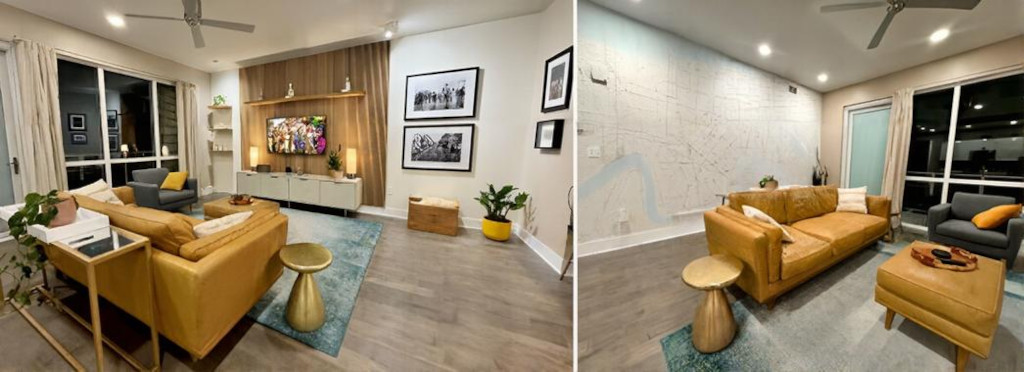
This is a Bywater short-term rental run small on purpose: one permitted unit, lived in, and locally managed.
Each room reflects us. Alongside work by local artists, my own photography hangs on the walls, my son picked a favorite Nola artist whose piece anchors his room. We’ve even mixed in a couple of works from artists in our mountain town. Guests are greeted by notes with our favorite neighborhood spots, and a large map of NOLA fills a wall. It’s our place, and we’re everywhere in it—furniture we actually live with, colors and textures we chose, stories on the shelves. The photos here show the rooms as they’re lived in, and that lived in care sets a quiet tone that invites guests to treat the home—and the Bywater—with the respect it deserves.
My model is the opposite on purpose: one permitted home, small footprint, and a local manager— Book NOLA—who answers, enforces, and fixes things the same day. I acknowledge that I am out of town, but if I’m not there, you can bet that I will use one of the few in-town management companies—people with a purpose and eyes on the ground when I can’t be there. I’m involved because it’s my home, even if I’m only there a couple months a year.
Book NOLA: local and responsible
I work with Book NOLA, a local manager focused on owners like me, not big portfolios. Expectations are frontloaded—guests confirm quiet hours, building rules, and access before booking. No one-night parties, no shellgame hosts, an age floor that screens out the worst ideas. Compliance is baseline; fewer, better stays beat churn. Accountability stays local: noise thresholds tied to quiet hours, calm human outreach, same-day fixes by in-house staff or vetted trades. The respect shows up in the boring stuff—housekeeping that doesn’t announce itself, deliveries that don’t clog the street, and a manager who walks over instead of “opening a ticket.” The money stays here too—cleaners and contractors who live in New Orleans, and guest recs that support nearby spots.
Why New Orleans?
Why New Orleans? I’ve lived in my share of big, polished cities—some scrubbed so clean they felt joyless. New Orleans still feels alive. I’m in the Bywater. It’s rough and beautiful at once—wrought iron, murals, a corner that smells like coffee, another that smells like last night. A serious food scene next to a bar with a jukebox that actually understands a Tuesday. It’s accessible. It’s human. I miss it on the flight home, and on the drive into the mountains – that doesn’t happen when I leave anywhere else.
I’ve lived across the country—always in cities—and grew up in NYC in the ’70s & 80s, returning in the 90s for a bit. About eleven years ago, I left the city grind for the mountains because being a weekend warrior and the sterilization of gentrification wore me down. New Orleans feels like the last real city that isn’t Disneyfied, and it’s the only place that still calls me off the ridge and back to a street that’s alive.
My son loves New Orleans for the simple stuff: walking the neighborhood, schnitzel at Bratz Y’all (I’ll get the brat, thanks), chasing lizards in Crescent Park, ducking into galleries and museums, even a Saints game when we can swing it. For summer, he chose Art Camp 504 over the mountains with school friends—new friends here matter to him. That says something about the city, and why I’m here. When he’s at camp, I’m on my bike chasing po’boys, soul food, and deep Cajun or Creole—in no particular order.
On my best days: a morning run—cut through Crescent Park to the Quarter, home along Dauphine or Royal, zigzagging because it feels good to belong for a minute. Shower. Coffee on the balcony. Then a day with my son—gecko hunting, kicking a ball, wandering toward the Quarter. Nothing and everything at once. Dinner. A quick bike to Robert’s for groceries or a walk to Pizza Delicious. Sometimes I leave my son at home—his own time on the phone or games with friends—and slip to Bacchanal for a glass of wine, prawns, and backyard music. Maybe a ride to Spotted Cat for a set. This is what part-time looks like for me— not running to the must-sees or checking boxes. No FOMO, no itinerary. Just being here, living the day that shows up. None of that makes me a “local.” It just keeps me honest about why I’m here: to be part of the life that’s already happening, not to bend it around me.
I’m careful with language. I don’t call myself a local. I haven’t lived what this city has lived—Katrina, Rita, the long, ugly years after. I know what I don’t know, so I try to lead with respect and listening. The gentrification tightrope is real and painful. I don’t have a fix. I try to be a small net positive where my two feet are—spend time in the neighborhood, keep the place quiet and clean, and be reachable when something goes sideways. I left the crowds once; I don’t want to be part of causing that kind of over-gentrification here.
I keep the home set up as I like to live—local art, comfortable furniture, and clear, simple house rules posted about quiet hours, bins, and parking. It’s a small signal, but it sets expectations and keeps the building peaceful.
If I stop being a good neighbor
New Orleans is the first place in a long time that felt like it was choosing me back. I’m trying to be worthy of that. If I stop being a good neighbor, I’ll adjust—or I’ll drop the dream and move on. Simple as that. I love this place too much to be part of the problem.
Frequently Asked Questions
Find quick answers on how we balance high-quality guest experiences with strict neighborhood accountability and local New Orleans regulations.
How do you ensure short-term rental guests respect the Bywater neighborhood?
We foster respect by maintaining a “lived-in” environment filled with personal items and local art, which signals to guests that they are in a home, not a hotel. Additionally, our management team at Book NOLA frontloads expectations by requiring guests to confirm quiet hours, building rules, and an age floor before their booking is finalized.
What is the difference between a corporate STR and a locally managed rental?
A locally managed rental is typically operated by an individual homeowner who uses a boots-on-the-ground management company to handle immediate needs and enforcement. Unlike corporate portfolios that prioritize high-volume turnover, our model focuses on fewer, higher-quality stays that support local cleaners, contractors, and neighborhood businesses.
How does your New Orleans short-term rental comply with city regulations?
Our property operates with a commercial short-term rental license and strictly adheres to all city mandates regarding occupancy limits and permit displays. We support active enforcement by the city to eliminate illegal rentals, ensuring that only accountable, permitted hosts who respect neighborhood density caps are allowed to operate.
Who manages the property when the owner is not in New Orleans?
The property is managed by Book NOLA, a local New Orleans property management firm that provides same-day fixes and human outreach. This ensures there is always an accountable local contact available to neighbors and guests, preventing the common issues associated with absentee or remote management.
Do short-term rentals benefit the local Bywater economy?
Yes, responsible STRs benefit the economy by directing tourist spending toward neighborhood-specific businesses, such as Bywater Bakery and The Joint, rather than centralized hotel districts. By hosting guests who seek an authentic neighborhood experience, we help sustain local shops, galleries, and restaurants that residents also enjoy.
Have more questions?
Check out our FAQ page for more details.

Rob Herrmann
Based in Spearfish at the edge of the Black Hills with an eye towards more time in New Orleans. Husband, dad to twins and a neuro-spicy 11-year-old.
A midlife writer mapping mind, aging, family, and change. He shares more of his reflections on fatherhood, men’s health, and place at Half-Life.org.
Latest Articles

STRs vs. Hotels: Why Neighborhood Stays Feel More Authentic

Booking Direct vs Airbnb: What’s Best for Your New Orleans Vacation?

Last-Minute New Orleans Vacation Rentals: Tips for Finding the Best Deals
