
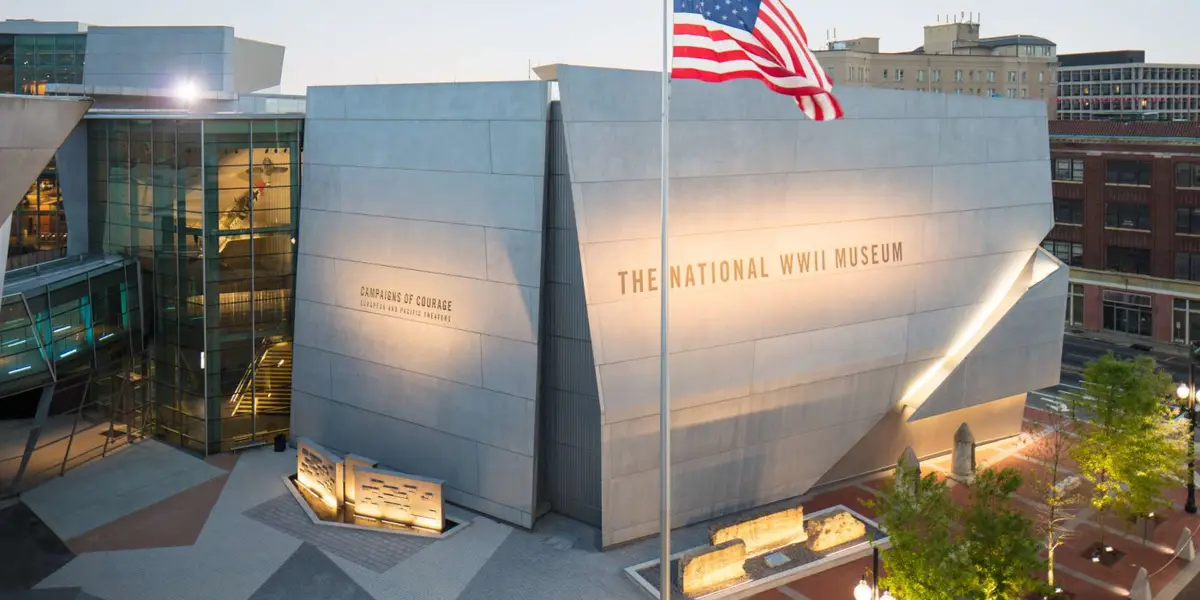
National WWII Museum in New Orleans with Kids: How I Actually Do It
Photo Credit: Nation WWII Museum
Key Takeaways
- Child-led pacing creates stronger engagement than forced full-museum completion.
- Arsenal of Democracy and Boeing Center offer the most accessible kid-friendly reset spaces.
- Liberation Pavilion discussions work best with honesty, brevity, and quiet reflection.
How I make the National WWII Museum my kid’s day
It’s great to take kids to museums for all the reasons you’ve considered, and a family visit to the National WWII Museum with kids can be a memorable experience for you all. My early mistake? Trying to make the visit about what I think they should get out of it—or worrying about my own experience. If the latter is your focus, go alone. If it’s the former, please read on, there’s even a museum route plan at the end of this post.
Make it their experience. Let them set the tone and pace, with your guidance—not direction. My son has ADHD and PDA, so any hint of “you must do this” turns exploration into a control battle. What I’ve learned with him helps neurotypical kids, too.
It’s easy to treat a place like the National WWII Museum as a forced-march learning opportunity where everything must be seen. I’ve done the forced march. Nobody had fun. My enthusiasm used to produce frustrated kids and a stressed-out dad—even with my neurotypical kids. Don’t do that to yourself or them.
Offer structure as options—dog tags, scavenger stations—not mandates. Follow their curiosity. I expected him to geek out on maps, interactives, and life-size exhibits—he did—but he lingered over a watch and helmet tied to a soldier from Ames, Iowa. That was my first test: I wanted to move him to the “next big thing.” Instead, I shut up and read with him. Guide, don’t direct. Take interest in what they’re interested in.
You can’t see it all. The place is huge, the era vast, the weight real. Don’t rush; focus on what lands. My son loves army men, Lego battle videos, and weaponry, but he surprised me in the Anne Frank exhibit. He knew far more about her and the persecution of Jews than I expected. It put me on my heels and made me proud—and I saw other kids doing the same with their parents.
Keep the tone light and respectful. The gravity is obvious; kids feel it without a lecture. Plant seeds, answer questions, then pause. Don’t downplay suffering for fear of upsetting sensitive kids—let empathy rise on its own—and share your reactions briefly when it’s honest and relevant. Don’t force “gratitude lessons.” Offer crumbs and see which ones they follow; circle back later if they want. Say less than you think you should; listen more than you want to.
I’ve been several times in the last couple of years—three with my youngest. My goal is to help you craft a National WWII Museum with kids visit that builds appreciation for the war effort and a fond family memory. One practical note: the museum map is vague. The theaters are designed to be seen in full, but with kids—neurodivergent or not—options matter. There are plenty of interactives, but we usually skip structured activities; PDA aside, Nate says they feel like school. He’s not wrong.
Planning your National WWII Museum visit with kids
Buy your tickets online to avoid long lines at the start of your visit—especially on peak days. There will be a line at security and to pick up your pre‑ordered tickets. Start early; future you will thank you.
Before proceeding, a note on add‑ons like Beyond All Boundaries. It runs about 48 minutes and is excellent, but on a full museum day I suggest sticking with General Admission unless your kid has the stamina for a long sit. No medals for squeezing everything in.
Your day will likely start at the Louisiana Memorial Pavilion, the National WWII Museum’s original building and gateway. After getting your tickets, staff may route you to the Train Car Experience, a recreated troop train with a short film framing the American story of WWII. It’s a clever, atmospheric intro—but in high season the line can feel endless to a kid. You’ve already stood in security and ticket lines; the payoff may not be worth the wait. If the line is short, do it; if not, skip the railcar and head upstairs.
Our kid-friendly route through the National WWII Museum exhibits
From that first building, I like to work in this order: Home Front and Merchant Marine, then the European and Pacific theaters, then the Tang and Boeing, and finally Liberation and the Holocaust.
Arsenal of Democracy
From the Louisiana Memorial Pavilion, head upstairs to the Home Front exhibits in Arsenal of Democracy, and keep an eye out for anything they can touch, spin, or step into. These galleries show how the U.S. mobilized factories, farms, families, and the Merchant Marine for total war, with immersive streetscapes, period media, and shipbuilding stories that make the “manufacturing front” feel real. A lot of the most kid‑friendly exhibits at the National WWII Museum are here: kitchens, living rooms, and shop floors that feel lived in instead of like a textbook. I’m a sucker for the reconstructed Jeep, ship models, and production displays—my son, not so much; I share my enthusiasm but don’t push. In the Merchant Marine section, point out the convoys and ship models, and how many civilian sailors never returned; even if he mainly notices the hardware, the idea of cargo crews facing torpedoes usually lands.
From there, go to the main WWII galleries covering the European and Pacific theaters. Think in arcs, not checklists: pick one or two stories—maybe D‑Day in Europe and island hopping in the Pacific—and accept that you won’t see every panel or artifact. Choose, commit, move.
European Theater
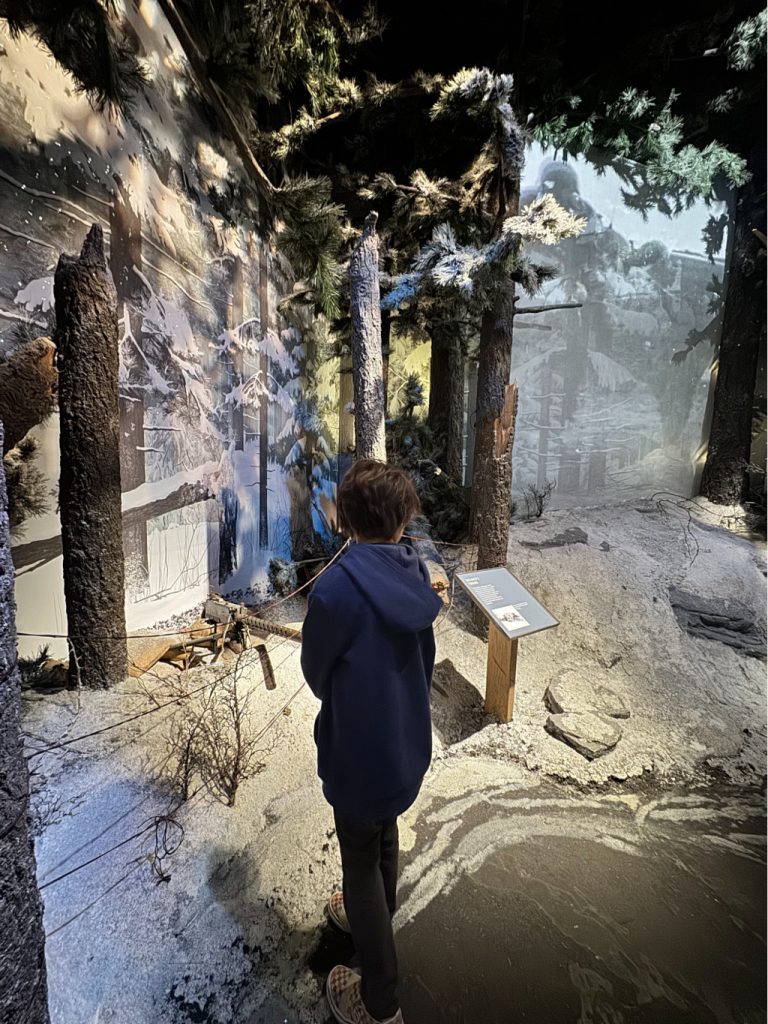
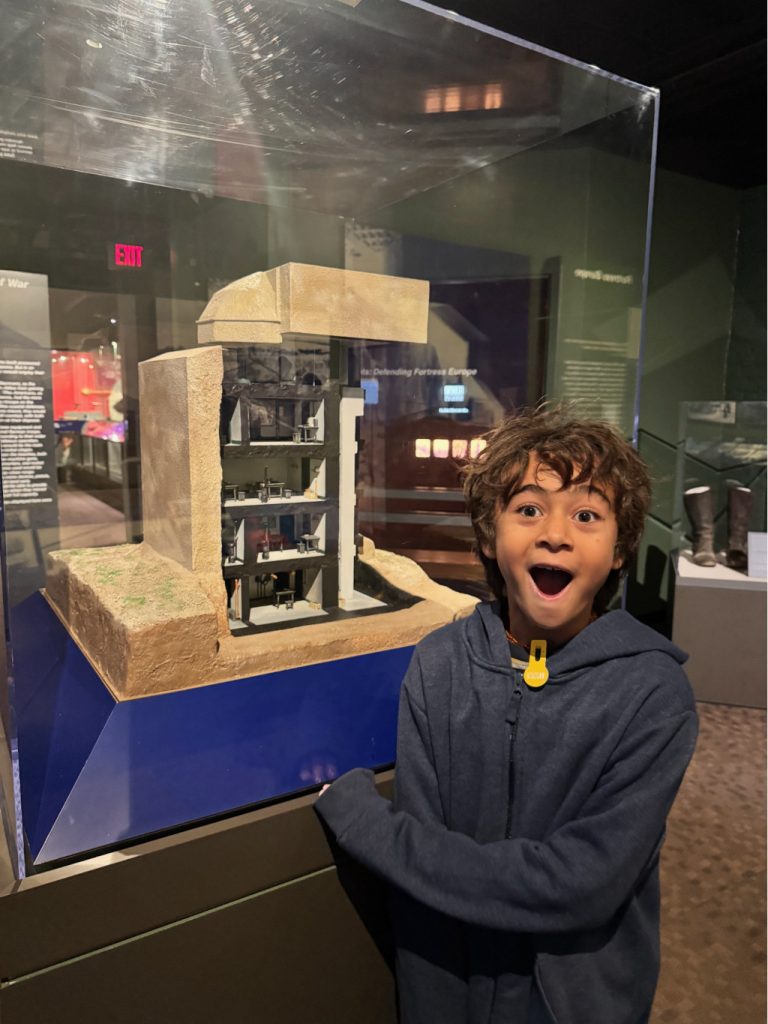
In the European galleries, the spaces do a lot of heavy lifting for kids: a shattered village street, a dim, snow‑heavy Battle of the Bulge room, a hidden gun—each scene changes the temperature and sound enough for them to feel the shift without another wall of reading. Linger at the D‑Day material: the maps and footage make sense of that impossible beach, and the rooms stitch together what it took to get ashore. If your kid likes gear, there are cases of small arms and kit (helmets, packs, rifles) and plenty of “how it worked” captions to skim together. Ours always beelines to the vehicles—Jeeps never get old—and we point out the troop glider, which makes the idea of silent, no‑engine landings feel real. I always want to linger in the Italian exhibits for family reasons. I’ve learned to keep it brief and steady—he absorbs more when I don’t load the moment. Lesson learned the hard way.
Pacific Theater
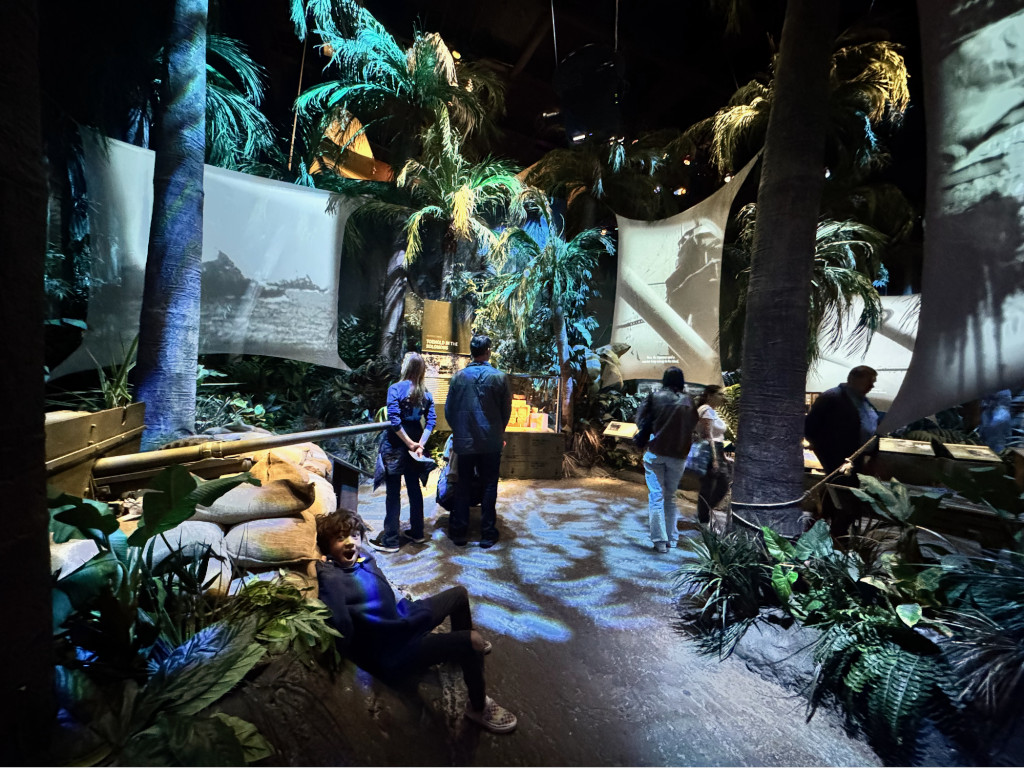
In the Pacific galleries, the route steps you from island to island—planes overhead, short film clips, knobs to turn, maps to trace with a finger. We follow the island‑hopping arc and make time for the Iwo Jima interactives—buttons, maps, short clips that reward quick attention spans on a family visit to the National WWII Museum. As that story winds down, the galleries carry you into the Hiroshima and Nagasaki rooms; we slow our pace, read a couple of first‑person accounts, and let the weight land without a lecture. I keep to a sentence or two and let the room’s mood work. It does.
Freedom Pavilion
Next, we change gears: we head to the USS Tang Submarine Experience in the U.S. Freedom Pavilion. It runs about eleven minutes in a fairly tight space, with sound, lights, and a bit of floor shake; you’re assigned a real crew member at the start, and at the end you learn who made it and who didn’t—which hits in a way a generic submarine display never could. It’s one of the most intense parts of a National WWII Museum visit with kids; great if they like immersion, too much if they’re sensitive to noise or sensory overload. No shame in skipping.
Exiting the Tang, we head to the Boeing Center—our reset zone and one of the easiest kid‑friendly things to do at the National WWII Museum. Walk the bridges and catwalks, look up at the suspended bombers and fighters, play “spot your favorite plane,” and take a breather from dense text. A few minutes up there resets us before we head toward Liberation and the emotional weight at the end of the day. Snacks help
Liberation, Anne Frank, and emotional weight
Visit the Liberation Pavilion, which covers the Holocaust, the end of the war, and its aftermath. The Anne Frank material and related exhibits on persecution and survival are powerful, even for younger kids. My son surprised me: he knew more than I expected, and the exhibit gave us a quiet, natural way to talk about it without a formal lecture. Next is the Pam and Mark Rubin Liberation Theater—survivors and liberators on screen. It isn’t flashy, just faces and voices, which held my son’s attention better than any panel. It got me, too.
The Holocaust video is hard but important. Watch body language. Let the weight land and answer questions. Nothing else in the National WWII Museum conveys the war’s brutality like this. Then take a walk.
What makes the National WWII Museum powerful for kids
The museum’s design carries the emotional weight; kids feel it in the photos, testimonies, and spaces. I keep my commentary light but honest—answering questions, naming feelings, then pausing—rather than turning it into a mandatory “lesson in gratitude.” The goal is to let empathy grow on its own while drawing a clear line between appreciation and celebration—and being present if something hits hard. If you do nothing else, guide, don’t direct. I remind myself of that all day.
One last stop to close the day: the John E. Kushner Restoration Pavilion
The John E. Kushner Restoration Pavilion is a great last stop. PT‑305—the “boat in the building”—sits at eye level, with walk‑around views, a periscope, and simple STEM stations that play with motion, incline, and force without feeling like school. Kids can roam, push buttons, try something once, then drift back to the hull or tools, and you don’t have to steer it. After the entire day, this space lets his shoulders come down; it’s still connected to the war, but in a looser, hands‑on way that feels like a decompression stop rather than one more thing we “have to” do on a National WWII Museum with kids route.We end here on purpose.
Our kid‑tested, no‑stress route that actually works at the National WWII Museum
- Start in the Louisiana Memorial Pavilion; do the Train Car only if the line is short, then head upstairs to the Home Front and Merchant Marine.
- Move through Arsenal of Democracy at their pace: point out one or two Home Front pieces (kitchen, living room, ship models, Merchant Marine convoys), then let them choose what to focus on. Resist the checklist.
- Head into the European theater and follow one main thread—D‑Day—letting the environments (ruined streets, winter scenes, vehicles) do the work. Stop when they stop; move when they’re done.
- Shift to the Pacific galleries and walk the island‑hopping arc; watch a short clip or two, then ease into Hiroshima and Nagasaki with time to feel the weight—no seminar.
- When everyone needs a reset, try the Tang submarine if tight, noisy spaces are okay—or skip it—and spend unhurried time in the Boeing Center catwalks playing “find your favorite plane” to reset.
- Make space near the end for Liberation, the Anne Frank material, and the Rubin Liberation Theater; let questions come rather than wrapping it in a big moral. Silence is okay.
- Finish in the John E. Kushner Restoration Pavilion—PT‑305, the periscope, and simple STEM stations—so they can touch, tinker, and decompress without sign‑ups or pressure to “get” anything specific.
Frequently Asked Questions
To help you navigate one of the world’s most immersive historical sites with your children, we’ve answered the most common questions about pacing, exhibits, and kid-friendly strategies.
What is the best way to pace a visit to the National WWII Museum with children?
The most effective approach is to adopt a child-led pace rather than a “forced-march” through every exhibit. Instead of treating the museum as a checklist, allow your child’s curiosity to dictate where you linger, and prioritize structure as options, such as interactive scavenger stations, rather than mandates.
Which exhibits are most engaging for high-energy kids or those with short attention spans?
The Boeing Center and the John E. Kushner Restoration Pavilion are ideal “reset zones” where kids can explore catwalks, view suspended aircraft, and engage with STEM-based stations. These areas offer a break from dense historical text and allow for hands-on movement, making them perfect for decompression between more somber galleries.
Should we include the “Beyond All Boundaries” film and the “Train Car Experience”?
You should only include the Train Car Experience if the wait time is short, as long lines can lead to early fatigue. For Beyond All Boundaries, consider your child’s stamina; it is a 48-minute commitment that may be too long for younger children or those already tired from exploring the main galleries.
How should parents approach sensitive topics like the Holocaust and the atomic bomb?
Maintain a tone that is light but respectful, allowing the museum’s design to convey the emotional weight naturally. Answer questions honestly and briefly, but avoid forcing “gratitude lessons.” Let empathy rise on its own by providing quiet reflection time in the Liberation Pavilion and Anne Frank exhibits.
Is the USS Tang Submarine Experience suitable for all children?
The USS Tang Experience is highly immersive and intense, featuring lights, sound, and a vibrating floor, making it great for kids who love “being in the action.” However, because it takes place in a tight, noisy space, it may be overwhelming for children who are sensitive to sensory overload.
Where can kids find hands-on or interactive activities in the museum?
The Arsenal of Democracy offers immersive streetscapes and “lived-in” kitchen and shop floor recreations that feel more tangible than textbooks. Additionally, the Restoration Pavilion features a periscope and motion-based stations that allow kids to tinker and decompress in a looser, hands-on environment at the end of the day.
Have more questions?
Check out our FAQ page for more details.

Rob Herrmann
Based in Spearfish at the edge of the Black Hills with an eye towards more time in New Orleans. Husband, dad to twins and a neuro-spicy 11-year-old.
A midlife writer mapping mind, aging, family, and change. He shares more of his reflections on fatherhood, men’s health, and place at Half-Life.org.
Latest Articles

Fall Festivals in New Orleans: A Complete Guide

Bywater Mural Guide: Self-Guided Street Art & Blue Bikes NOLA

STRs vs. Hotels: Why Neighborhood Stays Feel More Authentic